Why High-Brightness Displays Still Need Anti-Glare Film
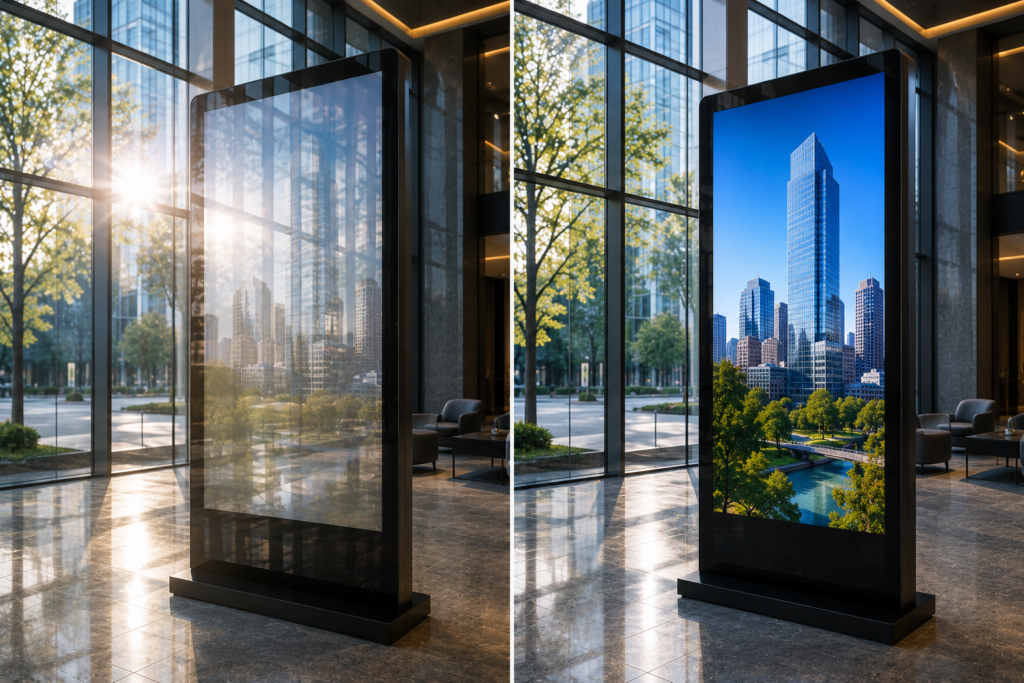
The Biggest Myth in Digital Signage
When visibility problems appear, most people assume the solution is simple:
Buy a brighter display.
It sounds logical.
After all, if a screen is difficult to see, increasing brightness should solve the problem.
However, that’s only partially true.
In reality, some of the brightest commercial displays on the market still suffer from severe visibility issues. As a result, businesses often spend significantly more money on premium hardware while continuing to struggle with glare.
Fortunately, understanding the difference between brightness and visibility can save organizations thousands of dollars.
Brightness and Visibility Are Not the Same Thing
Many people use these terms interchangeably.
However, they are completely different measurements.
Brightness
Brightness refers to how much light a display produces.
It is commonly measured in nits.
Visibility
Visibility refers to how easily people can read and understand the content on the screen.
A display can be extremely bright while still being difficult to read.
Why?
Because reflected light can overpower the image itself.
Therefore, visibility depends on both brightness and reflection control.
The Reflection Problem Nobody Accounts For
Imagine placing a 3,000-nit display directly across from a large glass storefront.
On paper, that display should be highly visible.
However, during certain hours of the day, direct sunlight may reflect across the screen.
As a result:
- Text becomes difficult to read
- Colors appear washed out
- Graphics lose contrast
- Customers stop paying attention
Meanwhile, the display is still producing maximum brightness.
The problem isn’t the display.
The problem is the reflected light sitting on top of the content.
Why Businesses Keep Buying More Brightness
Many organizations mistakenly diagnose glare problems as brightness problems.
Consequently, they often upgrade from:
- 700 nits to 1,500 nits
- 1,500 nits to 2,500 nits
- 2,500 nits to 3,500 nits
Yet visibility challenges frequently remain.
Furthermore, these upgrades introduce new expenses.
Higher Equipment Costs
Premium high-bright displays can cost substantially more than standard commercial screens.
Increased Energy Consumption
Brighter displays consume more power throughout the day.
Greater Heat Generation
Additional brightness creates more heat and stress on internal electronics.
Higher Long-Term Costs
Over time, energy, cooling, and maintenance expenses continue to increase.
Because of this, brighter displays often create a more expensive version of the same problem.
What Anti-Glare Film Does Differently
Anti-glare film approaches visibility from another angle.
Rather than producing more light, it reduces unwanted reflected light.
As a result:
- Screen content becomes easier to see
- Reflections become less distracting
- Contrast appears stronger
- Readability improves
- Touchscreen usability increases
Most importantly, anti-glare film helps maximize the performance of displays that are already installed.
High-Brightness Displays and Anti-Glare Film Work Together
This is where many people get confused.
Anti-glare film is not a replacement for brightness.
Instead, the two technologies complement each other.
A high-bright display combined with anti-glare film often delivers significantly better results than brightness alone.
Think of it this way:
Brightness increases the strength of the image.
Anti-glare film reduces the strength of competing reflections.
Together, they create a much more visible display.
Applications Where This Matters Most
The combination of brightness and glare reduction is especially valuable in:
Retail Storefronts
Large windows create constantly changing reflections.
Airports
Natural daylight floods terminal spaces throughout the day.
Museums
Architectural lighting often creates challenging viewing conditions.
Corporate Lobbies
Glass walls and polished surfaces generate reflections.
Universities
Wayfinding displays must remain visible from multiple angles.
Hospitals
Patients and visitors depend on clear information displays.
EV Charging Stations
Users need readable touchscreens in direct sunlight.
Because these environments cannot fully control lighting conditions, reflection management becomes critical.
The Hidden ROI of Better Visibility
Improving visibility creates benefits that extend beyond screen readability.
For example:
- Increased customer engagement
- Better promotional performance
- Improved touchscreen interaction
- Enhanced user experiences
- Stronger brand presentation
- Greater return on display investments
Consequently, organizations often discover that visibility improvements produce measurable business value.
Why Businesses Choose SSI Anti-Glare Solutions
At Screen Solutions International, anti-glare solutions are designed specifically for commercial display environments.
Benefits include:
- Reduced reflections
- Improved readability
- Enhanced customer engagement
- Better touchscreen performance
- Cost-effective visibility upgrades
- Professional appearance
Whether deployed on a single display or across an entire digital signage network, SSI anti-glare solutions help businesses get more from their display investments.
Learn more:
Final Takeaway
High-brightness displays are powerful tools.
However, brightness alone cannot solve every visibility problem.
When reflections dominate the viewing experience, even the brightest display can struggle.
Fortunately, anti-glare film helps reduce reflected light, improve readability, and maximize display performance.
Ultimately, the best visibility comes from balancing brightness with glare control.