Why Customers Ignore Glare-Covered Displays (And How to Fix It)
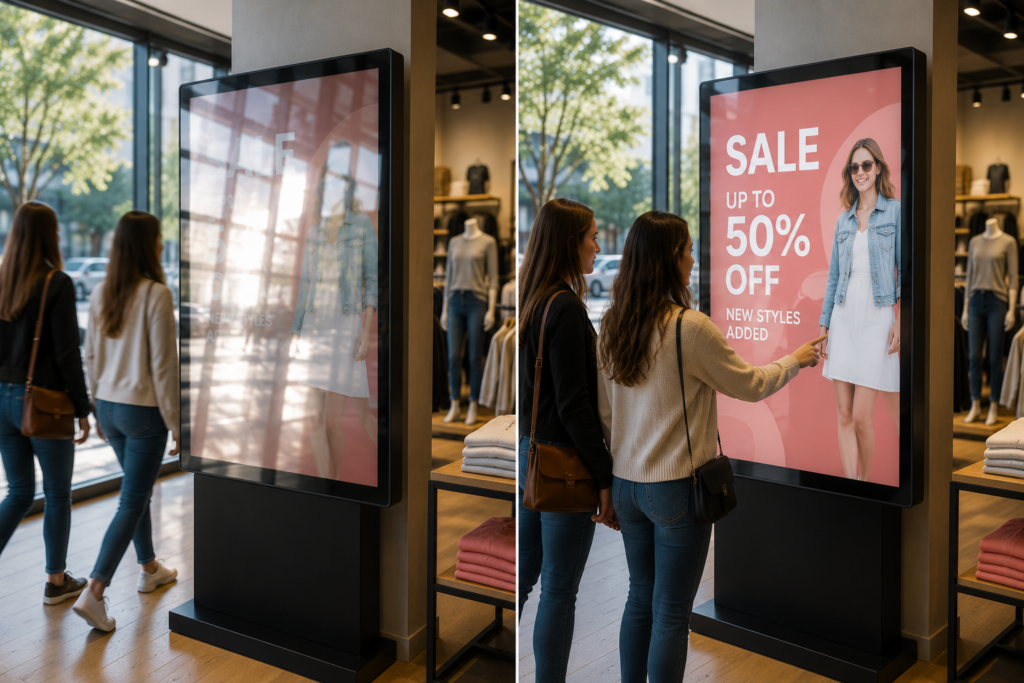
You Only Have Seconds to Capture Attention
Every display competes for attention.
Whether it’s a digital sign in a retail store, an interactive kiosk in a shopping mall, a menu board in a restaurant, or an information display in an airport, viewers make decisions almost instantly.
In fact, most people decide within a few seconds whether a display is worth looking at.
However, when glare covers the screen, that decision often happens even faster.
Instead of engaging with the content, viewers simply move on.
As a result, businesses lose opportunities to communicate, educate, promote, and sell.
Fortunately, many of these visibility issues can be solved without replacing the display itself.
The Human Brain Avoids Difficult Information
People naturally gravitate toward information that is easy to process.
Conversely, when information becomes difficult to read, the brain often chooses to ignore it altogether.
This is especially true in busy environments where people are already overloaded with visual stimuli.
For example:
- Retail stores
- Airports
- Museums
- Hotels
- Healthcare facilities
- Universities
- Transportation hubs
Because visitors are constantly filtering information, even a small amount of glare can dramatically reduce engagement.
Therefore, visibility directly influences whether a display succeeds or fails.
Glare Creates an Invisible Barrier
Many businesses focus on content design.
They optimize graphics, colors, animations, messaging, and branding.
However, none of that matters if customers cannot clearly see the screen.
Glare creates an invisible barrier between the viewer and the content.
As a result:
- Promotional messages get ignored
- Interactive displays receive less engagement
- Touchscreens become harder to use
- Brand messaging loses effectiveness
- Customer interactions decrease
Meanwhile, businesses often blame the content itself when visibility is actually the problem.
Why Bright Displays Still Get Ignored
A common misconception is that brighter displays automatically solve visibility issues.
However, brightness and visibility are not the same thing.
A display can be extremely bright while still suffering from poor readability.
For example, reflections from:
- Windows
- Skylights
- Overhead lighting
- Glass walls
- Polished floors
- Exterior sunlight
can overwhelm even a high-brightness screen.
Consequently, viewers see reflections instead of content.
Therefore, increasing brightness alone often produces disappointing results.
First Impressions Happen Instantly
Customers rarely stop and analyze why a display is difficult to view.
Instead, they simply move on.
This means businesses may never realize how many opportunities are being lost.
For example, a customer walking through a retail store may completely miss:
- A sale announcement
- A new product launch
- A loyalty program promotion
- A seasonal campaign
- An upsell opportunity
Likewise, visitors using public information displays may struggle to access important information.
As a result, the display fails to achieve its intended purpose.
Anti-Glare Film Helps Displays Get Noticed
Anti-glare film reduces reflections before they interfere with the viewing experience.
Rather than fighting glare with more brightness, anti-glare film addresses the source of the problem.
Benefits include:
- Improved readability
- Better contrast perception
- Reduced visual distractions
- Enhanced viewer engagement
- Improved touchscreen usability
- Increased content visibility
Consequently, viewers spend more time engaging with the display.
Retail Environments Benefit the Most
Retail spaces often contain some of the worst lighting conditions for digital displays.
For example, storefront windows generate direct sunlight while interior lighting creates additional reflections.
Because of this, digital signage can struggle to attract attention.
Anti-glare film helps retailers by:
Improving Promotional Visibility
Customers can see offers more clearly.
Enhancing Storefront Displays
Window-facing screens become easier to read.
Supporting Brand Messaging
Clear displays communicate professionalism and quality.
Increasing Engagement
Customers are more likely to interact with visible content.
As a result, businesses can maximize the effectiveness of their existing display investments.
Touchscreens Become More Inviting
Interactive displays rely on user participation.
However, when glare obscures menus and buttons, people often avoid interacting with the screen.
This affects:
- Kiosks
- Directories
- Self-service stations
- EV charging displays
- Ticketing systems
- Wayfinding screens
Fortunately, anti-glare film improves visibility and encourages interaction.
Therefore, users can complete tasks faster and with greater confidence.
Common Applications for Anti-Glare Film
Anti-glare solutions are frequently used on:
- Retail digital signage
- Interactive kiosks
- Corporate displays
- Airport information boards
- Museum exhibits
- Hospital directories
- Hotel displays
- University wayfinding systems
- EV charging stations
- Public information kiosks
Because visibility affects every one of these applications, glare reduction often delivers immediate benefits.
Why Businesses Choose SSI Anti-Glare Solutions
At Screen Solutions International, anti-glare films are engineered for commercial environments where display visibility directly impacts performance.
Benefits include:
- Reduced reflections
- Improved readability
- Better customer engagement
- Enhanced user experiences
- Cost-effective upgrades
- Professional appearance
Whether improving a single display or an entire signage network, SSI anti-glare solutions help businesses maximize the effectiveness of their technology investments.
Learn more:
Final Takeaway
Customers cannot engage with content they cannot clearly see.
Unfortunately, glare remains one of the most common reasons digital displays get ignored.
However, anti-glare film helps solve this problem by improving visibility, reducing reflections, and increasing viewer engagement.
Ultimately, the most effective display is not necessarily the brightest one.
It is the one people can actually see.