The $20,000 Display Problem Nobody Talks About
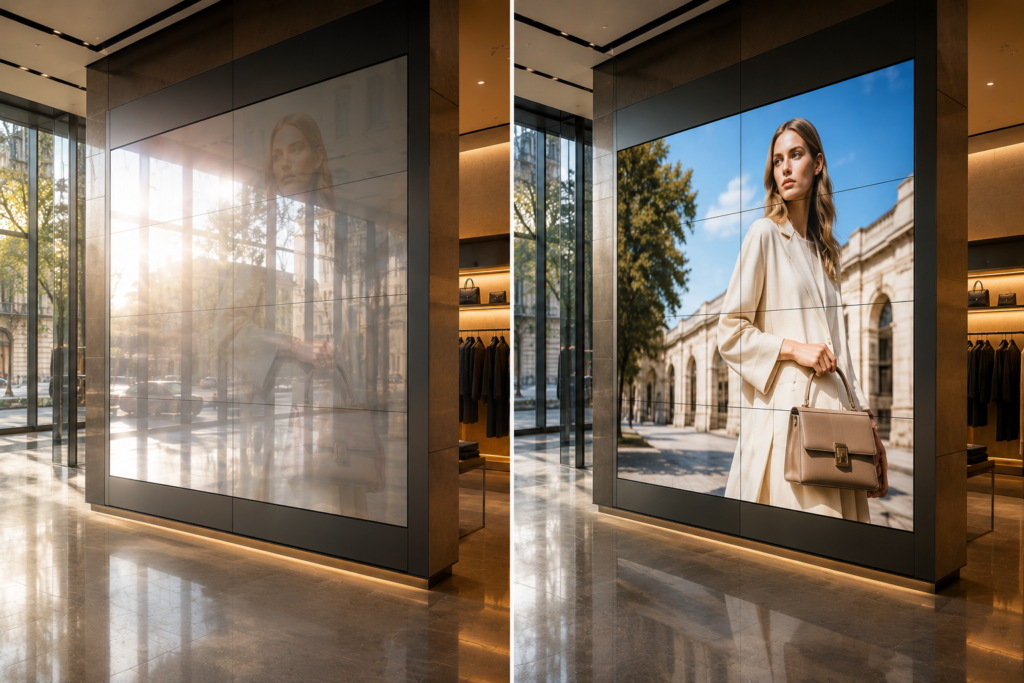
Why Expensive Displays Still Fail
Businesses spend thousands—even tens of thousands—of dollars on digital displays.
They invest in larger screens, higher resolutions, brighter panels, premium content, and sophisticated software platforms. As a result, expectations are high.
However, many of those same displays fail for a surprisingly simple reason:
People can’t see them.
Not because the content is bad.
Not because the technology is outdated.
And not because the display isn’t bright enough.
Instead, glare quietly destroys visibility before the message ever reaches the viewer.
Unfortunately, this problem is so common that many organizations never realize it exists.
The Display Is Working. The Environment Isn’t.
Most display buyers focus on hardware specifications.
They compare:
- Resolution
- Brightness
- Pixel density
- Contrast ratios
- Processing power
- Content management systems
However, visibility is ultimately determined by the environment surrounding the display.
For example:
A beautiful 4K display positioned across from a glass storefront may become unreadable for several hours each day.
Likewise, a high-brightness touchscreen kiosk installed beneath skylights may struggle despite its premium specifications.
Therefore, the display itself is often not the problem.
The environment is.
The Human Eye Doesn’t Care What You Paid
Customers don’t know whether a display cost $2,000 or $20,000.
They only know whether they can see it.
If glare covers:
- Pricing
- Promotions
- Directions
- Menus
- Product information
- Flight updates
- Interactive buttons
then the display immediately becomes less effective.
Consequently, expensive technology can perform no better than a much cheaper alternative.
In some cases, it performs worse because expectations are higher.
Every Reflection Competes With Your Message
Think of your display as trying to win a battle for attention.
Your content competes against:
- Sunlight
- Ceiling lights
- Glass walls
- Vehicle headlights
- Storefront windows
- Polished floors
- Architectural reflections
The stronger the reflection becomes, the weaker your message appears.
Eventually, reflections dominate the viewing experience.
At that point, customers stop reading.
Because of this, glare directly reduces communication effectiveness.
The Real Cost Isn’t the Display
The real cost of glare is rarely measured.
Businesses typically calculate:
- Hardware costs
- Installation costs
- Software subscriptions
- Content creation expenses
However, they rarely calculate lost engagement.
Consider the impact of:
- Missed promotions
- Lower customer interaction
- Reduced upsell opportunities
- Poorer customer experiences
- Longer interaction times
- Increased customer frustration
These losses occur every day without generating an invoice.
Nevertheless, they can be far more expensive than the display itself.
Why More Brightness Isn’t Always Better
When visibility problems appear, many organizations immediately look for brighter screens.
However, brightness is only one side of the equation.
The other side is reflection control.
A brighter display can still struggle when reflections are strong enough.
Additionally, increasing brightness often creates:
Higher Equipment Costs
Premium high-bright displays can cost substantially more.
Increased Energy Usage
Higher brightness requires additional power.
More Heat
Displays running hotter often experience increased wear.
Greater Operating Expenses
Over time, power and maintenance costs continue to accumulate.
Therefore, simply adding brightness does not always provide the best return on investment.
The Smarter Solution: Control the Reflections
Anti-glare film improves visibility by reducing reflected light before it reaches the viewer.
Rather than overpowering glare, it minimizes the glare itself.
As a result:
- Content becomes easier to read
- Touchscreens become easier to use
- Viewer engagement improves
- Displays appear more professional
- Existing hardware performs better
Most importantly, anti-glare film helps maximize the value of technology that businesses already own.
Industries Where Visibility Directly Impacts Performance
The effects of glare are especially noticeable in:
Retail Stores
Promotions and branding become easier to see.
Airports
Passengers can quickly locate important travel information.
Museums
Interactive exhibits become more engaging.
Hospitals
Visitors can navigate facilities more efficiently.
Universities
Wayfinding systems become easier to use.
Restaurants
Digital menu boards remain visible throughout the day.
EV Charging Stations
Users can clearly see charging instructions and payment information.
Because these environments rely heavily on visual communication, visibility improvements often produce immediate results.
Why Businesses Choose SSI Anti-Glare Solutions
At Screen Solutions International, anti-glare films are designed specifically for commercial applications where visibility drives performance.
Benefits include:
- Reduced reflections
- Improved readability
- Better touchscreen usability
- Enhanced customer engagement
- Cost-effective upgrades
- Professional appearance
Whether improving one display or thousands across a nationwide network, SSI anti-glare solutions help organizations get more from their technology investments.
Learn more:
Final Takeaway
The biggest problem with many displays isn’t the display itself.
It’s the glare sitting on top of it.
Organizations spend enormous amounts of money on hardware, content, and software while overlooking the factor that determines whether people can actually see the message.
Fortunately, anti-glare film provides a practical way to improve visibility, increase engagement, and maximize the value of existing displays.
Ultimately, the most effective display is not the most expensive one.
It’s the one people can clearly see.