How Anti-Glare Film Improves Digital Signage Visibility in Bright Environments
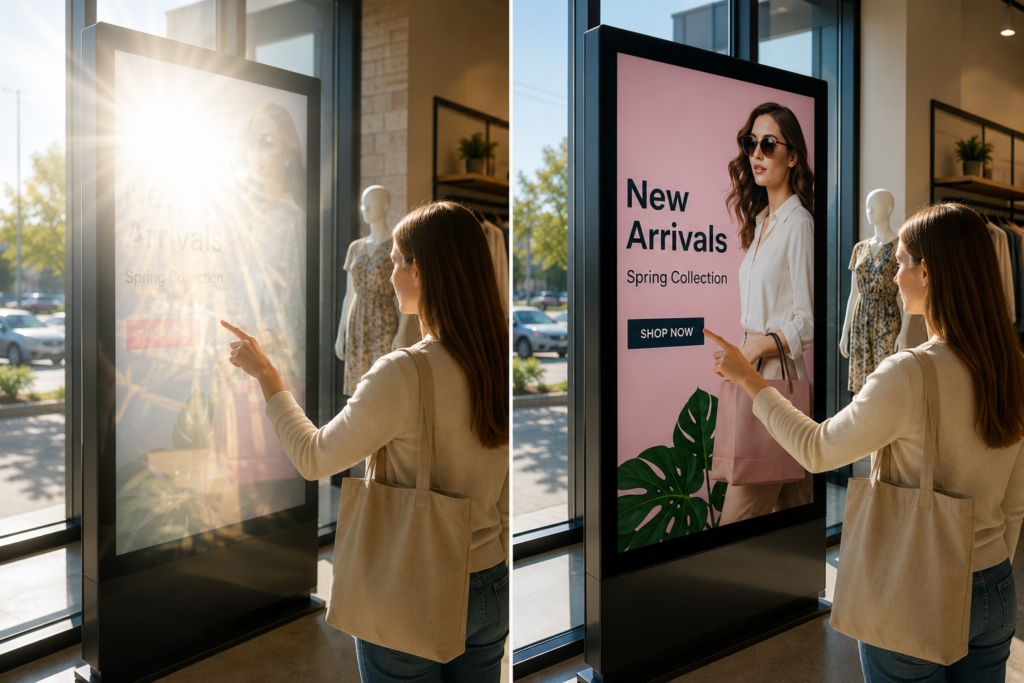
How Anti-Glare Film Improves Digital Signage Visibility in Bright Environments
Digital Signage Is Only Effective When People Can See It
Digital signage has transformed how businesses communicate with customers.
From retail stores and shopping malls to airports, banks, museums, restaurants, and corporate lobbies, digital displays now deliver critical information, promotions, wayfinding, and branding.
However, even the most expensive display installation can fail when visibility is poor.
The main problem is simple:
Glare.
When sunlight, overhead lighting, or reflected light hits a display, visibility can drop quickly. As a result, colors appear washed out, text becomes harder to read, and viewers lose interest faster.
Because of this, many businesses spend thousands of dollars on brighter displays. However, brightness alone does not always solve the problem.
Fortunately, anti-glare film helps improve display performance by reducing reflections before they interfere with the viewing experience.
Why Glare Hurts Digital Signage Performance
Most display manufacturers focus heavily on brightness specifications.
While brightness matters, it is only one part of the visibility equation.
The second factor is reflected light.
When reflections overpower the displayed content, visibility decreases dramatically. Consequently, customers may ignore the display entirely, even if the screen itself is high quality.
Common sources of glare include:
- Direct sunlight
- Storefront windows
- Skylights
- Interior lighting
- Glass walls
- Vehicle headlights
- Highly reflective architectural surfaces
Because these light sources change throughout the day, digital signage may look clear in the morning but difficult to read by afternoon.
Therefore, glare control should be considered during every digital signage installation.
What Is Anti-Glare Film?
Anti-glare film is an optical surface treatment designed to diffuse and reduce unwanted reflections.
Unlike traditional tinting products, anti-glare film helps maintain image quality while minimizing reflected light.
As a result, viewers experience:
- Better readability
- Improved contrast perception
- Reduced visual distractions
- Increased viewer engagement
- Improved display effectiveness
Additionally, the film can be applied directly to the display surface or protective glass.
Because of this, businesses can often improve visibility without replacing existing equipment.
Improve Readability Without Increasing Display Brightness
Many organizations try to solve glare problems by purchasing brighter displays.
However, brighter displays often introduce new challenges.
Increased Equipment Costs
Commercial high-bright displays can cost significantly more than standard screens.
Higher Energy Consumption
Additionally, higher brightness requires more power, which can increase operating costs.
Increased Heat Generation
Furthermore, displays running at maximum brightness create more heat and stress on internal components.
Shorter Equipment Lifespan
Over time, displays operating at higher output levels may experience accelerated wear.
By comparison, anti-glare film improves visibility without increasing power consumption.
Therefore, it often delivers a more cost-effective solution.
Retail Stores See Immediate Benefits
Retail environments rely heavily on visual communication.
Promotions, pricing, branding, and product messaging all depend on display visibility.
However, when glare hides content, those messages lose impact.
Anti-glare film helps retail businesses by:
Improving Promotional Visibility
Customers can read promotional content more easily and from greater distances.
Increasing Window Display Effectiveness
In addition, storefront digital signage becomes more visible during bright daylight conditions.
Enhancing Customer Experience
Reduced glare creates a cleaner and more professional presentation.
Supporting Brand Perception
Furthermore, clear displays communicate quality, care, and attention to detail.
As a result, retailers can maximize the value of existing digital signage investments.
Airports, Museums, and Public Spaces Benefit Too
Digital signage is frequently used in environments where lighting conditions cannot be fully controlled.
For example:
Airports
Flight information displays must remain readable throughout the day.
Museums
Interactive exhibits often sit beneath bright architectural lighting.
Universities
Wayfinding systems need clear visibility across large campuses.
Healthcare Facilities
Patients and visitors rely on digital directories and information screens.
In these environments, improved readability directly impacts usability.
Consequently, anti-glare film can support better navigation, faster decision-making, and smoother visitor experiences.
Anti-Glare Film Supports Touchscreen Performance
Touchscreens have become increasingly common across industries.
However, glare can make touchscreens frustrating to use.
Users often struggle to see buttons, menus, or information because reflections obscure the display. As a result, simple interactions can take longer than necessary.
Anti-glare film helps create:
- Better touch experiences
- Easier navigation
- Faster interaction times
- Reduced user frustration
- Improved accessibility
Therefore, interactive kiosks and touchscreen systems often benefit significantly from glare reduction.
Ideal Applications for Anti-Glare Display Film
Anti-glare solutions are commonly used on:
- Retail digital signage
- Interactive kiosks
- Corporate displays
- Museum exhibits
- Airport information screens
- Healthcare directories
- Hospitality displays
- Educational displays
- Transportation signage
- Public information systems
Because every environment has unique lighting conditions, anti-glare film provides a flexible visibility enhancement solution.
Additionally, it can support both single-display installations and larger display networks.
Why Businesses Choose SSI Anti-Glare Solutions
At Screen Solutions International, anti-glare solutions are designed for commercial applications where visibility directly impacts performance.
Benefits include:
- Improved display readability
- Reduced reflections
- Enhanced customer engagement
- Better user experiences
- Lower operational costs compared to display replacement
- Professional visual appearance
Whether protecting a single touchscreen or an entire network of digital signage displays, anti-glare film helps businesses get more value from their technology investments.
Learn more:
Final Takeaway
Digital signage only delivers results when people can clearly see the content.
Unfortunately, glare remains one of the most common obstacles to effective communication.
However, anti-glare film helps solve this problem by reducing reflections, improving readability, and enhancing customer engagement.
Instead of fighting reflections with more brightness, many organizations achieve better results by controlling glare at the source.
Ultimately, clearer displays create stronger communication, better experiences, and more value from every digital signage investment.