Introduction
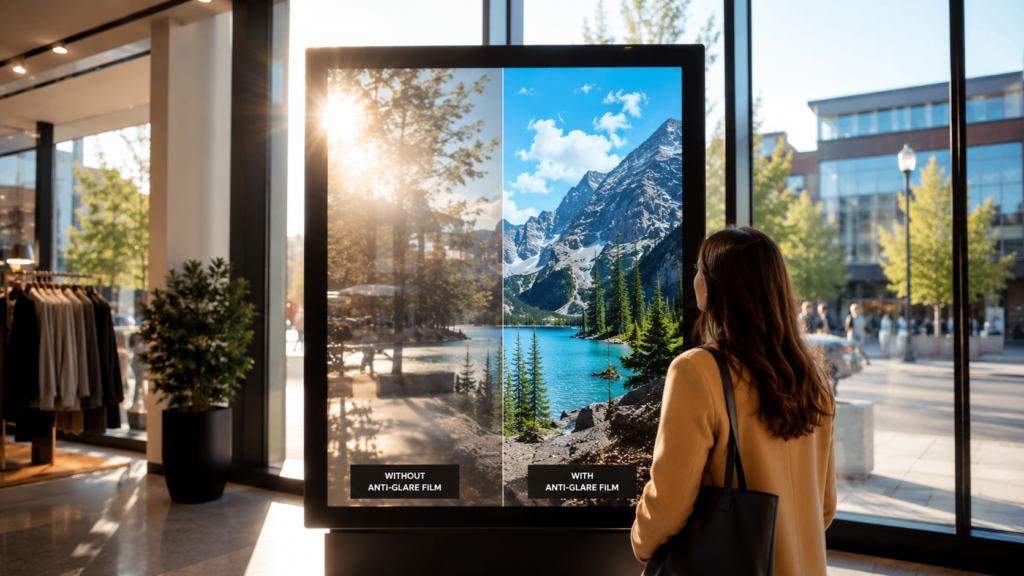
Screen Visibility Mistake issues cost businesses thousands of dollars every year. Although organizations spend significant money on digital signage, interactive kiosks, menu boards, video walls, and customer-facing displays, many overlook one critical factor: whether customers can actually see the screen. As a result, expensive technology investments often fail to deliver their full potential. Furthermore, glare, reflections, sunlight, and overhead lighting can make content difficult to read, which reduces engagement and weakens return on investment.
Many companies assume brighter screens solve the problem. However, increasing brightness often increases energy consumption, heat generation, and operating costs. Meanwhile, the real issue remains unchanged.
Customers cannot engage with content they cannot see.
Consequently, glare has become one of the most expensive and overlooked problems affecting commercial displays today.
The Hidden Cost of Poor Screen Visibility
Businesses invest in digital displays for one primary reason: communication.
Whether the goal involves advertising, wayfinding, customer service, education, or product promotion, the display must deliver information clearly and consistently.
Unfortunately, glare can undermine that objective immediately.
When reflections cover important content, businesses experience:
- Reduced customer engagement
- Lower advertising effectiveness
- Missed promotions
- Increased customer frustration
- Reduced dwell time
- Lower conversion rates
- Poor user experiences
- Lost revenue opportunities
Moreover, these problems often occur without management realizing the root cause.
A display may technically function perfectly while failing to communicate effectively.
That distinction matters.
Why Brightness Alone Doesn’t Solve the Problem
Many organizations respond to visibility issues by purchasing brighter displays.
Although high-brightness displays offer advantages, brightness alone cannot eliminate reflections.
Consider a storefront display facing direct sunlight.
Even if the screen produces exceptional brightness levels, glare can still create mirror-like reflections that compete with the displayed content.
Consequently, viewers may notice reflections before they notice advertisements.
Furthermore, brighter displays create additional challenges:
Increased Power Consumption
Higher brightness levels require more energy.
As energy costs continue rising, operating expenses increase as well.
More Heat Generation
Displays running at maximum brightness generate more heat.
Over time, excessive heat can affect performance and component longevity.
Increased Equipment Stress
When displays operate continuously at elevated brightness levels, internal systems experience additional wear.
As a result, maintenance requirements often increase.
Therefore, businesses should focus on improving visibility rather than simply increasing brightness.
What Causes Screen Glare?
Screen glare occurs when light reflects off a display surface and interferes with content visibility.
Several factors contribute to the problem.
Direct Sunlight
Sunlight remains one of the most significant causes of glare.
Storefront windows, outdoor kiosks, transportation terminals, and drive-thru displays frequently encounter direct solar exposure.
Overhead Lighting
Indoor environments present challenges as well.
Retail stores, airports, hospitals, and office buildings often contain powerful overhead lighting systems that create unwanted reflections.
Glass Surfaces
Modern commercial displays commonly utilize protective glass surfaces.
While glass improves durability, it can also create highly reflective viewing conditions.
Viewing Angles
Even moderate lighting conditions can create visibility issues when customers approach displays from certain angles.
Therefore, glare reduction solutions must account for real-world usage conditions rather than ideal laboratory environments.
Industries Losing Revenue Due to Glare
Retail Stores
Retailers depend on digital displays to attract attention and influence purchasing decisions.
However, storefront displays exposed to sunlight often become difficult to read.
Consequently, promotional messages lose effectiveness.
Restaurants
Digital menu boards help increase efficiency and improve customer experiences.
Unfortunately, glare can slow ordering processes and create confusion.
Banks and Financial Institutions
ATM screens and customer service kiosks must remain visible throughout the day.
Otherwise, customer satisfaction suffers.
Healthcare Facilities
Hospitals and medical centers increasingly use digital displays for navigation and communication.
Clear visibility remains essential.
Airports and Transportation Centers
Passengers rely heavily on digital information systems.
As a result, visibility issues can directly affect operational efficiency.
The Real ROI of Anti-Glare Film
Many businesses evaluate anti-glare film primarily as an aesthetic upgrade.
However, the financial benefits often extend far beyond appearance.
Increased Customer Engagement
Customers spend more time interacting with visible content.
Therefore, engagement rates improve significantly.
Better Advertising Performance
Marketing messages become easier to read.
As a result, promotional campaigns generate stronger results.
Improved User Experience
Customers appreciate displays that work consistently under all lighting conditions.
Consequently, overall satisfaction improves.
Reduced Need for Excessive Brightness
Anti-glare film helps displays remain readable without relying solely on maximum brightness settings.
This approach can help reduce operating costs.
Extended Equipment Life
Because displays may operate more efficiently, long-term stress on equipment can decrease.
Anti-Glare Film vs. Ignoring the Problem
| Factor | No Anti-Glare Film | Anti-Glare Film |
|---|---|---|
| Screen Visibility | Poor in challenging lighting | Consistently improved |
| Customer Engagement | Lower | Higher |
| Advertising Effectiveness | Reduced | Improved |
| User Experience | Inconsistent | Reliable |
| Display Readability | Limited | Enhanced |
| ROI Potential | Reduced | Increased |
| Brand Perception | Weakened | Strengthened |
For many businesses, the decision becomes straightforward once visibility issues are measured against lost opportunities.
Common Signs Your Business Has a Screen Visibility Problem
Many organizations do not recognize glare-related issues immediately.
Watch for these warning signs:
- Customers moving closer to displays
- Frequent complaints about readability
- Employees manually assisting users
- Reduced kiosk usage
- Poor digital signage engagement
- Displays facing windows or direct sunlight
- Fingerprints and reflections dominating screen surfaces
If multiple symptoms appear, glare likely contributes to the problem.
Where Anti-Glare Film Delivers the Greatest Impact
Interactive Kiosks
Interactive systems require clear visibility for successful operation.
Learn more:
https://www.ssidisplays.com/interactive-kiosks/
Digital Signage
Digital signage investments perform best when content remains visible throughout the day.
https://www.ssidisplays.com/digital-signage/
High-Brightness Displays
Combining high-brightness technology with anti-glare film often produces superior results.
https://www.ssidisplays.com/high-bright-displays/
LED Video Walls
Large-format installations benefit significantly from improved visibility.
https://www.ssidisplays.com/led-video-walls/
Transparent OLED Displays
Advanced display technologies deserve equally advanced visibility solutions.
https://www.ssidisplays.com/transparent-oled-displays/
Custom Experiential Displays
Immersive experiences depend on visual clarity.
Common Mistakes Businesses Make
Waiting Until Customers Complain
Many organizations address glare only after receiving complaints.
Instead, proactive evaluation helps avoid lost engagement.
Focusing Only on Hardware
Display performance involves more than brightness specifications.
Environmental conditions matter equally.
Choosing Generic Consumer Solutions
Commercial environments require commercial-grade products.
Professional anti-glare solutions deliver better long-term results.
Ignoring Window-Facing Displays
Storefront installations frequently experience the greatest visibility challenges.
Therefore, these displays deserve special attention.
Future Trends in Screen Visibility
The demand for digital experiences continues to grow.
Consequently, visibility optimization will become increasingly important.
Several trends are emerging:
More Outdoor Displays
Businesses continue expanding outdoor digital signage networks.
Increased Interactive Experiences
Touchscreen technology remains a major growth area.
Smarter Display Protection
Manufacturers continue developing advanced anti-glare and protective film technologies.
Experience-Driven Design
Organizations increasingly prioritize customer experience metrics when evaluating display investments.
As a result, visibility becomes a measurable business objective rather than a technical afterthought.
FAQ
Does anti-glare film affect image quality?
High-quality anti-glare films improve visibility while maintaining excellent image clarity.
Can anti-glare film be installed on existing displays?
Yes. Many commercial displays can be retrofitted with professionally installed anti-glare film.
Is anti-glare film useful indoors?
Absolutely. Overhead lighting and window reflections frequently create indoor visibility challenges.
Will anti-glare film eliminate all reflections?
No solution completely eliminates reflections. However, professional anti-glare films dramatically reduce glare and improve readability.
Which industries benefit the most?
Retail, healthcare, transportation, education, hospitality, financial services, museums, restaurants, and corporate environments all benefit significantly.
Why Choose Screen Solutions International
Screen Solutions International helps businesses maximize the performance of their display investments.
SSI provides:
- Anti-glare display solutions
- Digital signage systems
- Interactive kiosks
- LED video walls
- Transparent OLED displays
- High-brightness displays
- Digital spheres
- Projection systems
- Custom experiential displays
Because SSI understands both display technology and environmental challenges, clients receive solutions designed to improve visibility, engagement, and long-term return on investment.
Call:
888-631-5880
Visit:
Final Takeaway
The most expensive display problem isn’t equipment failure. Instead, it’s investing thousands of dollars into technology that customers struggle to see.
Glare silently reduces engagement, weakens marketing effectiveness, frustrates users, and limits return on investment. Meanwhile, many organizations continue spending more on brightness and hardware upgrades without addressing the root cause.
Anti-glare film offers a practical, cost-effective solution that improves readability, enhances customer experiences, and helps businesses maximize the value of their digital display investments.
If customers cannot clearly see your content, your display isn’t working as hard as it should. Fortunately, that problem is often easier to solve than most businesses realize.
Sources
Internal SSI Links
- https://www.ssidisplays.com/
- https://www.ssidisplays.com/digital-signage/
- https://www.ssidisplays.com/interactive-kiosks/
- https://www.ssidisplays.com/high-bright-displays/
- https://www.ssidisplays.com/led-video-walls/
- https://www.ssidisplays.com/transparent-oled-displays/