Why EV Charging Screens Need Anti-Glare Film More Than Ever
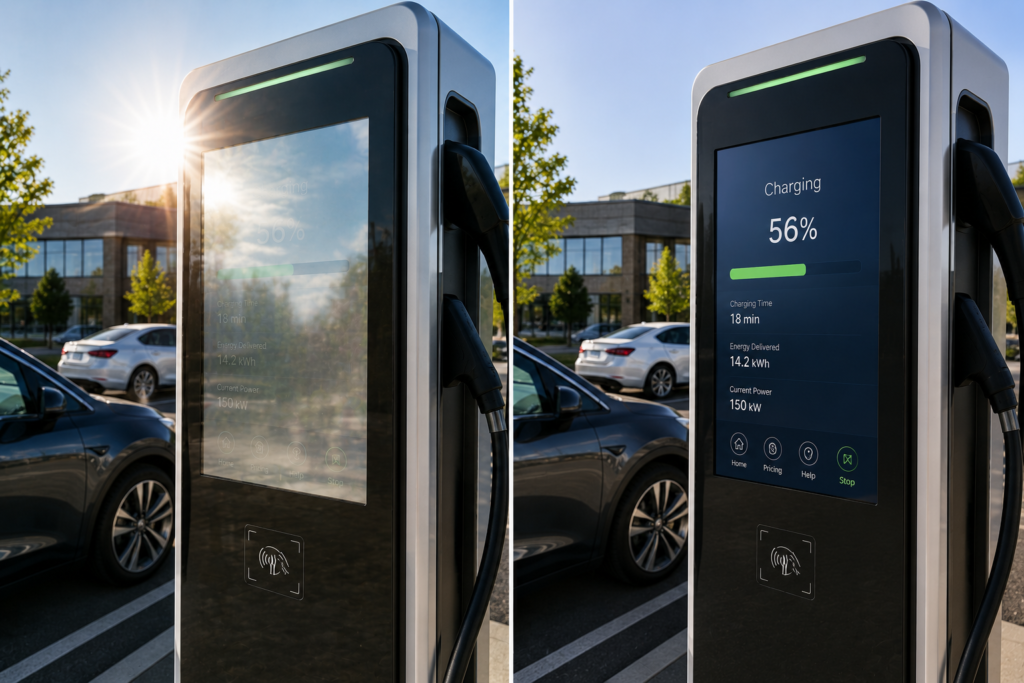
EV Charging Stations Have a Visibility Problem
Electric vehicle charging infrastructure is expanding rapidly.
Across North America, Europe, and beyond, EV charging stations are appearing in parking lots, retail centers, hotels, office parks, airports, apartment complexes, and public transportation hubs.
However, as charging technology evolves, another challenge is becoming increasingly obvious:
Screen visibility.
Most EV charging stations rely on touchscreens to guide users through payment, charging selection, account management, troubleshooting, and status monitoring.
Yet these screens often sit outdoors in direct sunlight.
As a result, glare can make charging stations frustrating to use.
Fortunately, anti-glare film helps solve one of the biggest usability challenges facing modern charging networks.
Drivers Depend on Charging Screens
Unlike traditional gas pumps, EV chargers often require multiple interactions.
Drivers may need to:
- Start charging sessions
- Process payments
- Select charging speeds
- Scan QR codes
- Monitor charging progress
- View pricing information
- Troubleshoot connection issues
- Access support information
However, when glare covers the display, even simple tasks become difficult.
Consequently, users may experience delays, frustration, and confusion.
Because charging sessions already require time and patience, poor screen visibility can significantly impact customer satisfaction.
Outdoor Environments Create Constant Glare
Most EV chargers operate in uncontrolled lighting environments.
For example, charging stations frequently encounter:
- Direct sunlight
- Reflections from nearby vehicles
- Parking lot lighting
- Glass storefront reflections
- Wet pavement reflections
- Seasonal lighting changes
Furthermore, glare conditions change throughout the day.
A screen that appears perfectly visible at 9 AM may become difficult to read by noon.
Therefore, charging operators must consider visibility across a wide range of lighting scenarios.
Bright Screens Alone Cannot Solve the Problem
Many charging manufacturers attempt to improve visibility through higher brightness.
While brighter screens can help, they do not eliminate reflections.
In fact, reflected sunlight can still overwhelm high-brightness displays under certain conditions.
Additionally, brighter screens often introduce:
Higher Energy Consumption
More brightness requires more power.
Increased Heat Generation
Displays operating at maximum output generate additional heat.
Higher Equipment Costs
Premium outdoor displays typically cost more.
Increased Component Wear
Over time, higher operating temperatures can affect long-term reliability.
Because of this, brightness alone rarely provides the complete solution.
Anti-Glare Film Improves User Experience
Anti-glare film addresses visibility from a different perspective.
Rather than increasing screen output, it reduces the reflections competing with the displayed content.
As a result, drivers experience:
- Improved readability
- Better touchscreen usability
- Faster transaction completion
- Reduced user frustration
- Improved accessibility
- Greater confidence during charging sessions
Consequently, charging stations become easier and more intuitive to use.
Faster Interactions Mean Better Throughput
Visibility affects more than convenience.
It also affects operational efficiency.
When users struggle to read screens, transaction times increase.
For busy charging locations, these delays can create bottlenecks.
By improving visibility, anti-glare film helps users complete interactions more quickly.
Therefore, charging operators can improve both customer experience and station utilization.
Why Fleet Operators Are Paying Attention
Commercial fleet electrification is growing rapidly.
As delivery vehicles, service fleets, and transportation companies adopt EVs, charging infrastructure becomes increasingly important.
Fleet operators need:
- Reliable charging
- Fast user interaction
- Consistent screen visibility
- Reduced operational downtime
Because charging efficiency directly affects productivity, visibility improvements become increasingly valuable.
Ideal Applications for Anti-Glare Film
Anti-glare film performs exceptionally well on:
Public EV Chargers
Improve visibility for everyday drivers.
Fleet Charging Stations
Support faster vehicle turnaround.
Fast Charging Networks
Reduce transaction friction.
Commercial Parking Facilities
Enhance user experiences.
Multi-Family Residential Charging
Improve accessibility for residents.
Workplace Charging Systems
Support employee convenience.
Because these environments often operate outdoors, glare reduction delivers immediate benefits.
Why Charging Network Operators Choose SSI Anti-Glare Solutions
At Screen Solutions International, anti-glare films are engineered for commercial environments where visibility directly impacts usability.
Benefits include:
- Reduced reflections
- Improved touchscreen performance
- Better readability
- Enhanced customer satisfaction
- Cost-effective upgrades
- Professional appearance
Whether deployed across a nationwide charging network or a single installation, SSI anti-glare solutions help maximize display performance.
Learn more:
https://www.antiglarefilms.com
Final Takeaway
As EV charging infrastructure continues to expand, user experience becomes increasingly important.
Unfortunately, glare remains one of the most common obstacles to effective touchscreen interaction.
Fortunately, anti-glare film helps improve readability, reduce frustration, and create a smoother charging experience.
Ultimately, charging stations should be easy to use in every lighting condition—not just the perfect ones.