Why Anti-Glare Film Is Becoming Essential for Smart Buildings
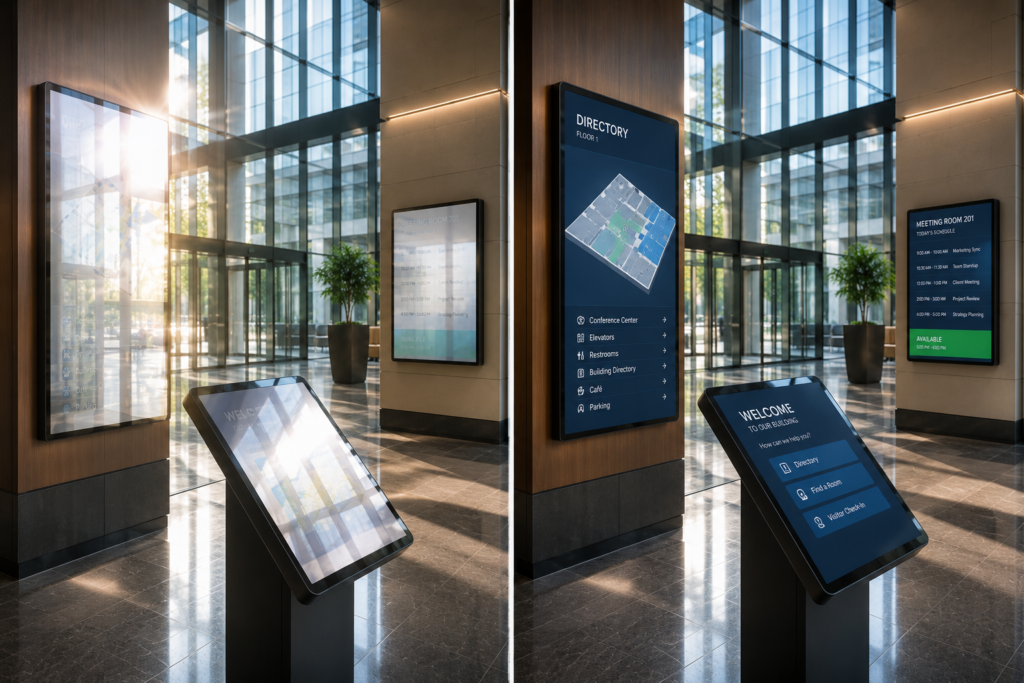
Modern Buildings Are Filled With Screens
Today’s commercial buildings rely heavily on digital technology.
Walk through a modern office tower, hospital, university, airport, hotel, or corporate headquarters and you’ll likely encounter dozens—or even hundreds—of displays.
These screens power:
- Building directories
- Meeting room scheduling systems
- Interactive kiosks
- Employee communication boards
- Digital wayfinding
- Security monitoring systems
- Visitor check-in stations
- Corporate branding displays
However, as buildings become smarter and more connected, one surprisingly simple issue continues to impact screen performance:
Glare.
Even the most advanced display systems can become difficult to use when reflections interfere with visibility.
As a result, many smart buildings struggle to deliver the seamless digital experience they were designed to provide.
The Glass Problem in Modern Architecture
Modern architecture loves glass.
Floor-to-ceiling windows, glass partitions, skylights, glass conference rooms, and open atrium designs have become standard features in commercial construction.
While these architectural elements create beautiful environments, they also create ideal conditions for screen glare.
For example:
- Sunlight reflects off glass walls.
- Skylights create shifting glare throughout the day.
- Polished flooring amplifies reflections.
- Interior lighting creates additional hotspots.
Consequently, digital displays often compete against their surroundings for visibility.
Smart Buildings Depend on Instant Communication
Unlike traditional signage, smart building displays often provide time-sensitive information.
Employees and visitors rely on screens to:
- Find meeting rooms
- Locate departments
- Navigate large facilities
- Check room availability
- View schedules
- Access visitor information
- Monitor building announcements
However, when glare reduces readability, users become frustrated.
Furthermore, delays in accessing information can create bottlenecks throughout the building.
Therefore, display visibility directly impacts operational efficiency.
Why Touchscreen Performance Suffers
Touchscreens are particularly vulnerable to glare.
When users cannot clearly see menus, buttons, or instructions, interactions become slower and less intuitive.
For example, visitors using a lobby directory may struggle to find destinations. Meanwhile, employees may have difficulty reserving conference rooms through scheduling displays.
As a result:
- Navigation takes longer
- User frustration increases
- Touchscreen adoption decreases
- Customer satisfaction suffers
Fortunately, anti-glare film helps improve touchscreen visibility without changing the underlying technology.
Anti-Glare Film Improves Existing Infrastructure
One of the biggest advantages of anti-glare film is that it enhances displays already in service.
Rather than replacing screens, organizations can improve visibility by reducing reflected light.
Benefits include:
- Improved readability
- Better touchscreen usability
- Enhanced contrast perception
- Reduced visual distractions
- Increased user engagement
- Professional presentation
Because the solution works directly on the display surface, implementation is often far less expensive than hardware replacement.
Conference Rooms Benefit Significantly
Conference rooms have become technology hubs.
Many now include:
- Room scheduling displays
- Interactive collaboration screens
- Video conferencing systems
- Digital whiteboards
- Presentation displays
However, these rooms frequently contain glass walls and bright lighting.
Consequently, glare can make collaborative technology more difficult to use.
Anti-glare film helps ensure participants can focus on content instead of reflections.
Improving the Visitor Experience
Visitors form impressions quickly.
When digital systems are easy to use, organizations appear modern, organized, and professional.
However, glare-covered displays can create the opposite impression.
By improving visibility, anti-glare film helps:
- Simplify navigation
- Reduce confusion
- Improve accessibility
- Create smoother visitor journeys
- Enhance brand perception
As a result, visitors spend less time searching for information and more time focusing on their destination.
Ideal Smart Building Applications
Anti-glare film performs exceptionally well on:
Digital Directories
Improve readability in lobby environments.
Room Scheduling Displays
Support efficient meeting management.
Interactive Wayfinding Kiosks
Enhance touchscreen usability.
Visitor Check-In Stations
Improve the onboarding experience.
Corporate Communication Displays
Ensure important messages remain visible.
Security Monitoring Screens
Improve operator visibility and situational awareness.
Because smart buildings increasingly depend on visual communication, glare reduction has become more important than ever.
Why Facility Managers Choose SSI Anti-Glare Solutions
At Screen Solutions International, anti-glare films are designed for commercial environments where visibility directly affects user experience.
Benefits include:
- Reduced reflections
- Improved readability
- Enhanced touchscreen performance
- Better visitor experiences
- Cost-effective upgrades
- Professional appearance
Whether deployed in a single lobby or across an entire building portfolio, SSI anti-glare solutions help maximize display effectiveness.
Learn more:
https://www.antiglarefilms.com
Final Takeaway
As smart buildings continue to add more displays, visibility becomes increasingly important.
Unfortunately, modern architectural designs often create the exact conditions that cause glare.
Fortunately, anti-glare film helps organizations improve readability, enhance touchscreen performance, and create better user experiences without replacing existing hardware.
Ultimately, smarter buildings deserve smarter visibility solutions.
Sources
https://www.antiglarefilms.com