 What Is Anti-Glare Film and How Does It Work?
What Is Anti-Glare Film and why does it matter? Digital displays are everywhere now, They guide customers through stores, help travelers find gates, let drivers pay at gas pumps, support ATM transactions, display restaurant menus, power museum exhibits, and run interactive kiosks in public spaces.
However, even the best display can fail at one simple job:
Being visible.
When sunlight, overhead lighting, storefront glass, polished floors, or glossy surfaces create reflections, the screen becomes harder to read. As a result, customers squint, move around, tap the wrong button, miss information, or ignore the screen completely.
That is where anti-glare film comes in.
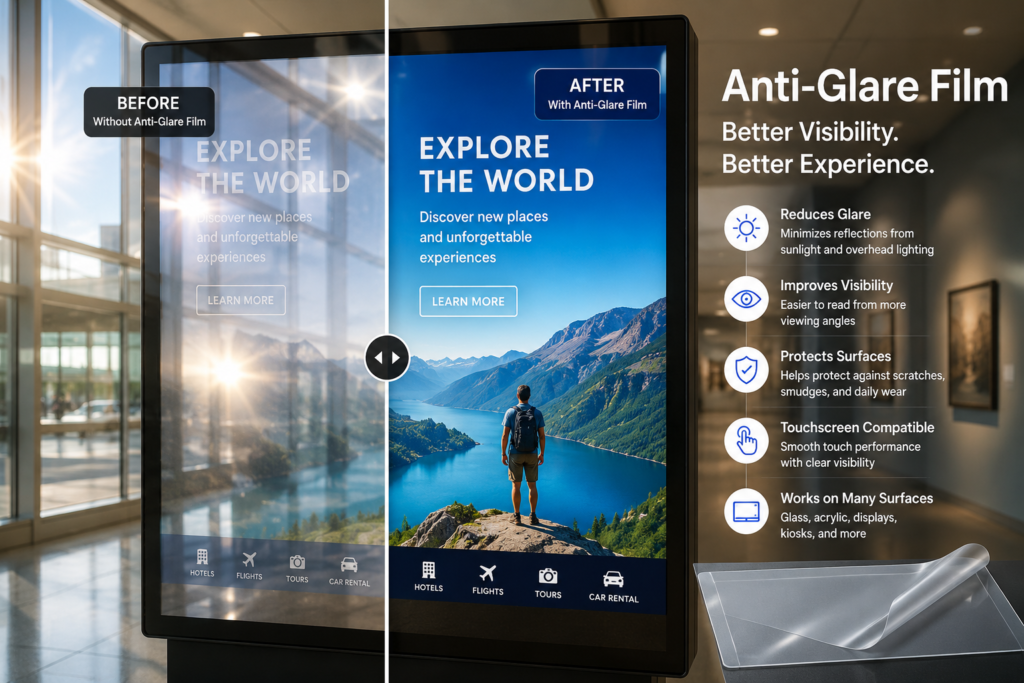
Anti-glare film is a surface-applied film designed to reduce reflections on display glass, acrylic panels, touchscreens, protective covers, kiosks, signage, and other customer-facing screens. Instead of letting harsh light bounce directly back toward the viewer, the film helps soften and diffuse reflections so the surface becomes easier to see.
In simple terms, anti-glare film helps turn a reflective surface into a more readable one.
What Is Anti-Glare Film?
Anti-glare film is a thin optical film applied to a screen-facing surface to help reduce glare and reflections.
It can be used on many clear surfaces, including:
- Display glass
- Protective glass
- Acrylic panels
- Touchscreen surfaces
- Kiosk face panels
- Gas pump screens
- ATM display windows
- Retail storefront displays
- Museum exhibit glass
- Menu board covers
- Outdoor signage covers
- Custom clear panels
The film does not make the display brighter. Instead, it improves how the surface handles reflected light.
That distinction matters.
If a display is too dim, a brighter display may help. However, if the display is bright enough but the surface is reflecting the room, sky, sunlight, lights, or viewer, anti-glare film may be the smarter first step.
How Does Anti-Glare Film Work?
Anti-glare film works by reducing sharp, mirror-like reflections.
Glossy glass and acrylic surfaces reflect light in a direct way. Because of that, you may see sunlight, ceiling lights, windows, vehicles, people, or surrounding objects on the screen surface.
Anti-glare film changes how light behaves at the surface. Rather than allowing one harsh reflection to bounce directly toward the viewer, the film helps scatter reflected light across the surface.
As a result, the reflection becomes softer and less distracting.
This helps the viewer focus on the screen content instead of the reflection.
Why Glare Makes Displays Hard to See
Glare reduces visibility because it competes with the content on the screen.
For example, a digital menu board may show food photos, prices, and combo options. However, if the surface reflects bright ceiling lights, customers may struggle to read the menu quickly.
Likewise, an outdoor kiosk may have a working touchscreen and strong brightness. Still, if direct sun reflects off the cover glass, the interface can become difficult to use.
Glare can affect:
- Screen readability
- Touchscreen usability
- Customer confidence
- Viewing angles
- Accessibility
- Menu speed
- Transaction flow
- Advertising impact
- Wayfinding clarity
- Exhibit visibility
- Overall display performance
In short, glare turns a display problem into a customer experience problem.
Common Places Where Anti-Glare Film Is Used
Anti-glare film works best when a screen or clear panel needs to stay readable in difficult lighting.
Outdoor Displays
Outdoor displays face sunlight, weather covers, pavement reflections, vehicle reflections, and changing sun angles. Therefore, anti-glare film can help improve visibility on outdoor digital signage, public information screens, and exterior kiosks.
Kiosks
Kiosks need to be easy to read and easy to use. Anti-glare film helps improve visibility on ordering kiosks, payment kiosks, wayfinding displays, ticketing screens, hotel check-in kiosks, and public self-service terminals.
Gas Pump Screens
Gas pump screens often sit in bright outdoor conditions. Even under a canopy, sunlight and vehicle reflections can make payment prompts, fuel instructions, loyalty screens, and video ads harder to see.
ATMs
ATM screens need to be readable during secure customer transactions. Anti-glare film can help reduce reflections on outdoor ATMs, drive-up banking screens, and financial kiosks.
Retail Displays
Retail storefront screens often compete with sunlight, windows, polished floors, and mall lighting. Anti-glare film helps promotional content, product displays, and customer-facing screens stay easier to view.
Touchscreens
Touchscreens need clear visibility before users interact. Anti-glare film can help customers read buttons, menus, maps, forms, payment prompts, and instructions more easily.
Museums and Exhibits
Museums use display glass, acrylic panels, touchscreens, and digital storytelling screens. Anti-glare film helps visitors focus on the exhibit instead of reflections from lights, glass cases, or gallery surroundings.
Acrylic Panels
Acrylic is lightweight and useful, but it can reflect heavily. Anti-glare film can improve visibility on acrylic display covers, kiosk panels, museum panels, menu covers, and protective clear surfaces.
Menu Boards
Restaurant menu boards must be readable fast. Anti-glare film helps customers see food items, prices, photos, specials, and ordering prompts under bright indoor or outdoor lighting.
Control Rooms
Control rooms rely on long-duration screen visibility. Anti-glare film can help reduce reflections on monitoring displays, dashboards, command center screens, and operator workstations.
Anti-Glare Film vs. Anti-Reflective Glass
Anti-glare film and anti-reflective glass are related, but they are not the same thing.
| Feature | Anti-Glare Film | Anti-Reflective Glass |
|---|---|---|
| Application | Applied to an existing surface | Built into or applied to glass during manufacturing |
| Best For | Retrofits, displays, acrylic covers, kiosks, touchscreens | Premium glass installations and new builds |
| Cost | Usually more practical for existing screens | Often more expensive |
| Replacement Needed | Usually no | Usually yes if existing glass is not already AR glass |
| Custom Sizing | Available | Requires custom glass sourcing |
| Use Case | Existing screens and display surfaces | High-end glass replacement projects |
Anti-reflective glass may make sense for premium new installations. However, anti-glare film is often more practical when the display, glass, or acrylic surface already exists.
Anti-Glare Film vs. Replacing the Display
Many customers assume they need a new screen when the current display is hard to read. Sometimes that is true. However, glare is often a surface problem, not a display failure.
| Problem | Replace Display | Add Anti-Glare Film |
| Screen is too dim | May help | Does not increase brightness |
| Surface reflects sunlight | May not solve it | Helps reduce glare |
| Protective glass reflects | Still possible | Helps reduce reflections |
| Existing display still works | Expensive upgrade | Easier retrofit |
| Touchscreen surface has glare | New display may still reflect | Helps improve surface visibility |
| Large rollout | Higher cost | More practical |
| Surface needs protection | Still exposed | Adds protective layer |
The key question is simple:
Is the screen too dim, or is the surface too reflective?
If brightness is the issue, display replacement may help. If reflection is the issue, anti-glare film may be the better place to start.
Standard Anti-Glare Film vs. Ultra Clear Anti-Glare Film
Not every project needs the same film.
Some applications need strong glare reduction. Others need glare control while maintaining a cleaner, sharper visual appearance.
Standard Anti-Glare Film
Standard anti-glare film is best when practical glare reduction is the main priority.
Use it for:
- Outdoor displays
- Kiosks
- Gas pumps
- ATMs
- Menu boards
- Basic digital signage
- Acrylic covers
- Public-facing utility screens
Ultra Clear Anti-Glare Film
Ultra Clear Anti-Glare Film is best when display clarity and premium appearance matter more.
Use it for:
- Retail storefront displays
- Museums
- Luxury showrooms
- Premium signage
- Touchscreens
- Corporate lobbies
- Gallery displays
- High-end customer-facing screens
Quick Recommendation
Use Standard Anti-Glare Film when glare reduction and protection are the top priorities.
Use Ultra Clear Anti-Glare Film when the display needs to look cleaner, sharper, and more premium.
Can Anti-Glare Film Be Used on Touchscreens?
Yes, anti-glare film can be used on many touchscreen applications, depending on the touchscreen type and surface.
However, touchscreen projects need extra review.
Before ordering film for a touchscreen, confirm:
- Is the screen touch-enabled?
- Is it glass or acrylic?
- Will users touch the film directly?
- Is the screen indoors or outdoors?
- Is the screen capacitive or resistive touch?
- Is the display behind protective glass?
- Is image clarity or glare reduction more important?
If you do not know the touchscreen type, send photos and the display model. That allows the application to be reviewed before recommending a film.
Can Anti-Glare Film Be Used on Acrylic?
Yes, anti-glare film can be used on many acrylic panels.
Acrylic is common because it is lightweight, clear, and easy to fabricate. However, it scratches more easily than glass and can attract static dust. Because of that, acrylic needs careful cleaning and handling before installation.
Common acrylic uses include:
- Kiosk panels
- Display covers
- Museum exhibit panels
- Retail display cases
- Menu board covers
- Protective screen overlays
- Custom clear panels
- Outdoor display covers
For premium acrylic applications, Ultra Clear Anti-Glare Film may be the better choice.
What Measurements Are Needed?
To quote anti-glare film correctly, measure the exact visible area where the film will be applied.
Send:
- Width
- Height
- Quantity
- Surface type
- Application type
- Touchscreen or non-touchscreen
- Indoor or outdoor use
- Standard or Ultra Clear preference
- Photos of the surface
- Photos showing the glare issue
For multiple displays, list each size separately.
Example:
| Surface | Size | Quantity |
| Kiosk touchscreen | 21″ × 14″ | 8 |
| Menu board cover | 48″ × 27″ | 6 |
| Gas pump display | 10″ × 7″ | 40 |
Accurate measurements help prevent waste, delays, and fit issues.
Installation Considerations
Anti-glare film performs best when installed on a clean, smooth surface.
Before installation, the surface should be:
- Clean
- Smooth
- Dry
- Free of dust
- Free of oil
- Free of fingerprints
- Free of old adhesive
- Free of deep scratches
- Accurately measured
- Accessible for application
For large displays, touchscreens, acrylic panels, museum exhibits, outdoor screens, or multi-location projects, professional installation may be recommended.
Common Mistakes to Avoid
Measuring the Wrong Area
Measure the surface where the film will be applied, not always the full display housing.
Forgetting the Surface Type
Glass and acrylic require different handling. Touchscreens need additional review.
Skipping Photos
Photos help confirm glare source, surface type, bezel condition, and installation details.
Choosing Only Based on Price
Standard film may be right for utility screens. However, Ultra Clear film may be better for premium customer-facing displays.
Assuming Film Makes the Screen Brighter
Anti-glare film does not increase display brightness. It reduces surface reflections so the screen can be easier to see.
Ignoring Installation Conditions
Dust, poor cleaning, outdoor weather, and rushed installation can affect the final result.
Future Trends in Anti-Glare Film and Display Visibility
As commercial displays become more common, anti-glare solutions will become more important.
Expect more demand for:
- Touchscreen-compatible anti-glare surfaces
- Premium low-haze films for retail and museums
- Outdoor display visibility upgrades
- Custom-cut film for kiosk fleets
- Better acrylic display cover solutions
- Anti-glare solutions for EV chargers
- Improved visibility for public information screens
- Multi-location film rollout programs
- Display protection paired with glare reduction
The future of digital signage is not just brighter screens. It is smarter surface control.
Final Takeaway
Anti-glare film helps reduce reflections on displays, glass, acrylic, touchscreens, kiosks, signage, and protective covers.
It does not make a screen brighter. Instead, it helps reduce the surface glare that makes screens harder to read in bright environments.
For outdoor displays, kiosks, gas pumps, ATMs, menu boards, acrylic panels, museums, touchscreens, and digital signage, anti-glare film can be a practical way to improve visibility without replacing the display.
If you know your screen size, surface type, quantity, and application, you are ready to request a quote.
FAQ
What is anti-glare film?
Anti-glare film is a surface-applied film that helps reduce reflections on display glass, acrylic panels, touchscreens, kiosks, signage, and protective covers.
Does anti-glare film make a screen brighter?
No. Anti-glare film does not increase screen brightness. It reduces surface reflections so the existing screen can be easier to see.
Can anti-glare film be used outdoors?
Yes, depending on the surface and exposure. Outdoor displays, kiosks, gas pumps, ATMs, and signage are common applications.
Can anti-glare film be used on touchscreens?
Yes, depending on the touchscreen type and surface. Always confirm touchscreen use when requesting a quote.
Can anti-glare film be applied to acrylic?
Yes. Anti-glare film can be used on many acrylic panels, including display covers, kiosk faces, exhibit panels, and protective surfaces.
What is the difference between Standard and Ultra Clear Anti-Glare Film?
Standard Anti-Glare Film is best for practical glare reduction. Ultra Clear Anti-Glare Film is better when image clarity and premium appearance matter more.
Do I need professional installation?
Small projects may be customer-installed. However, large displays, touchscreens, outdoor screens, acrylic panels, museums, and multi-location projects may benefit from professional installation.
What information is needed for a quote?
Send width, height, quantity, surface type, application type, touchscreen status, indoor or outdoor use, and photos showing the glare issue.