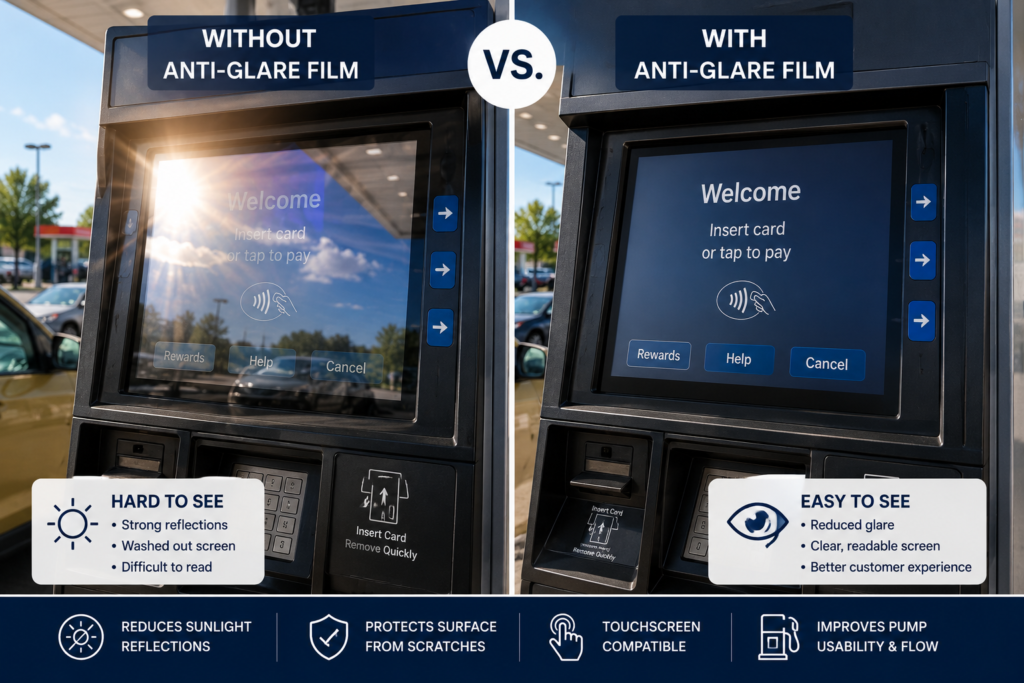
 Why Gas Pump Screens Are Hard to See in Sunlight
Gas pump screens have one job:
Help customers complete the fueling process quickly.
They show payment prompts, loyalty offers, fuel instructions, touchscreen buttons, receipt options, video ads, safety messages, car wash prompts, and confirmation screens.
However, many gas pump screens struggle with a frustrating problem.
They are hard to see in sunlight.
Even when the screen is technically working, customers may still have trouble reading it. Bright daylight, reflections, canopy lighting, vehicle glare, protective glass, acrylic covers, and glossy screen surfaces can all make the display harder to use.
As a result, customers squint, shield the screen with their hand, tap the wrong button, cancel prompts, skip loyalty offers, or ask for help.
That is not just annoying. It affects transaction flow, customer experience, media visibility, loyalty program engagement, and pump usability.
Fortunately, many gas pump visibility problems are caused by surface glare, not complete display failure. That means anti-glare film may be a practical way to improve readability without replacing the entire pump display system.
Why Gas Pump Screens Have So Much Glare
Gas pump screens are installed in one of the hardest display environments.
They are outdoors, public-facing, touched constantly, surrounded by vehicles, and exposed to changing sunlight throughout the day.
Common glare sources include:
- Direct sunlight
- Reflected sunlight
- Vehicle windshields
- Chrome and metallic vehicle surfaces
- Concrete pavement
- Fuel canopy lighting
- Pump face reflections
- Protective glass
- Acrylic screen covers
- Glossy display surfaces
- Nearby windows
- Customer viewing angles
- Bright sky reflections
Even under a canopy, gas pump screens can still reflect daylight from the open sides of the station.
That means shade alone does not always solve the problem.
The Screen May Not Be the Real Problem
When a gas pump screen is hard to read, many operators assume the display is too dim or failing.
Sometimes that is true.
However, the issue is often surface reflection.
A screen may have enough brightness, but the protective cover or glass in front of it reflects the environment. In that case, replacing the screen may not fix the problem because the new screen can still reflect sunlight from the same surface.
Before replacing hardware, ask:
Is the screen too dim, or is the surface reflecting light?
| Problem | Possible Cause | Better First Step |
|---|---|---|
| Screen looks dark all day | Low brightness or aging display | Display service or replacement |
| Screen reflects cars or sunlight | Surface glare | Anti-glare film |
| Touch buttons are hard to see | Glare on touchscreen surface | Touchscreen-compatible anti-glare film |
| Screen is readable at night but poor in daylight | Sunlight reflection | Anti-glare film or placement review |
| Protective cover reflects heavily | Glass or acrylic glare | Film for glass or acrylic |
| Screen has scratches or haze | Surface damage | Surface review or replacement |
If the display is functioning and glare is the main issue, Anti-Glare Film for Gas Pumps may be the better first step.
How Sunlight Affects Gas Pump Displays
Sunlight creates visibility problems in several ways.
Direct Sunlight
When sunlight hits the screen surface directly, it can create bright glare spots that wash out payment prompts, buttons, and instructions.
Reflected Sunlight
Even if the sun is not directly hitting the screen, sunlight can reflect off vehicles, pavement, nearby glass, or the fuel canopy.
Changing Sun Angles
A screen that looks fine in the morning may become difficult to read in the afternoon. Sun angle changes throughout the day, so visibility problems may come and go.
Bright Ambient Light
Even without a sharp reflection, high daylight levels can reduce perceived contrast and make on-screen content harder to read.
Protective Surface Reflection
Many gas pump screens sit behind glass, acrylic, or another protective window. That outer surface may reflect more than the display itself.
Because of these factors, gas pump screens need both display brightness and surface glare control.
Why Protective Glass and Acrylic Covers Can Make Glare Worse
Gas pump screens need protection.
They are exposed to weather, fingerprints, cleaning, public use, fuel station dust, and daily wear. Therefore, many pump screens use protective glass or acrylic covers.
However, that protective surface can become the glare source.
Glass and acrylic can reflect:
- Sunlight
- Vehicle headlights
- Fuel canopy lights
- Customer clothing
- Pavement
- Nearby pumps
- Bright sky
- Station windows
If the protective cover is glossy, scratched, dirty, or poorly angled, reflections can become even worse.
Anti-Glare Film for Acrylic Panels can be useful when the pump screen uses an acrylic cover. For glass surfaces, standard anti-glare film may be the practical fit.
How Anti-Glare Film Helps Gas Pump Screens
Anti-glare film helps reduce harsh reflections on display-facing surfaces.
It works by softening mirror-like reflections so the screen content becomes easier to see.
For gas pumps, anti-glare film can help improve visibility on:
- Payment screens
- Touchscreen prompts
- Loyalty program displays
- Fuel selection screens
- Receipt option screens
- Car wash offer screens
- Video ad displays
- Confirmation messages
- Safety instructions
- Pump media screens
Anti-glare film does not make the screen brighter. Instead, it reduces surface reflections so the existing display can be easier to read.
That distinction matters because many gas pump screens are not failing. They are simply fighting the sun.
The sun usually wins unless you cheat. Anti-glare film is the cheat code.
Standard or Ultra Clear Film for Gas Pumps?
For most gas pump screens, practical visibility is the main goal.
That means Standard Anti-Glare Film is usually the better starting point.
Use Standard Anti-Glare Film When:
- Glare reduction is the top priority
- The screen is outdoors
- The display is utility-focused
- Customers need to read prompts quickly
- The screen shows payment, fuel, loyalty, or receipt options
- Cost-effective visibility improvement matters
- There are multiple pumps or locations
Consider Ultra Clear Anti-Glare Film When:
Ultra Clear Anti-Glare Film may be worth considering when the screen has a premium visual purpose.
Examples include:
- High-end fuel station media screens
- Premium convenience store branding
- Indoor payment kiosks
- Customer experience displays
- Advertising screens where image clarity matters
- EV charging displays with premium interface design
However, for most pump transaction screens, Standard Anti-Glare Film is the practical workhorse.
Gas Pump Touchscreens Need Special Review
Many modern fuel pumps use touchscreens.
Touchscreens require extra review because customers interact directly with the surface. The film must support both visibility and usability.
Anti-Glare Film for Touchscreens can be used in many applications, but the screen type and surface details matter.
Before requesting a quote for gas pump touchscreens, confirm:
- Is the screen touch-enabled?
- Is the surface glass or acrylic?
- Will customers touch the film directly?
- Is the screen behind protective glass?
- Is the screen outdoors full-time?
- Is the pump under a canopy?
- Does the screen have buttons, sensors, or cutouts nearby?
- Is glare worse at a specific time of day?
If you do not know the touchscreen type, send photos and pump details through the Request an Anti-Glare Film Quote page.
Gas Pump Screens vs. Other Outdoor Displays
Gas pump screens are similar to other outdoor displays, but they have extra challenges.
Like Outdoor Digital Displays, gas pump screens face sunlight, reflections, and high ambient light.
However, gas pump displays also deal with:
- Frequent customer touch
- Fuel station grime
- Cleaning chemicals
- Vehicle reflections
- Payment interaction
- Fast customer decisions
- Media and loyalty prompts
- Multiple screens per location
- Repeated daily use
- Outdoor exposure
Because of this, the surface needs to remain visible, usable, and cleanable.
Anti-glare film can support that goal when selected and installed correctly.
Why Glare Hurts Fuel Station Performance
Glare is not just a visual issue.
At the pump, it can affect real business outcomes.
Slower Transactions
If customers cannot read prompts, they take longer to complete payment and start fueling.
Lower Loyalty Program Engagement
If loyalty prompts are hard to see, customers may skip them.
Missed Car Wash Offers
Upsell prompts need to be visible at the right moment. Glare can reduce their effectiveness.
Weaker Pump Media Performance
Video ads and promotional content lose impact when the screen is washed out by reflections.
More Customer Frustration
Nobody enjoys fighting a screen while standing in the sun next to a pump.
More Staff Assistance
If customers cannot complete transactions easily, they may need help from employees.
Accessibility Issues
Clear screen visibility supports a better experience for more users.
In short, readable pump screens matter.
What About EV Charger Displays?
EV charger screens face many of the same visibility problems as gas pump screens.
They are often outdoors, customer-facing, and used for payment or session control.
EV charger displays may show:
- Charging instructions
- Payment prompts
- Session status
- Pricing
- Connector information
- Account login
- QR codes
- Error messages
- Advertising content
As EV charging infrastructure grows, glare reduction will become more important for these screens as well.
The same basic strategy applies: confirm whether the issue is screen brightness or surface reflection, then evaluate anti-glare film if glare is the main problem.
How to Measure Gas Pump Screens for Anti-Glare Film
To quote gas pump anti-glare film correctly, measure the exact screen-facing surface where the film will be applied.
This may be:
- The display glass
- The touchscreen surface
- A protective window
- An acrylic cover
- A pump media screen
- A larger pump face panel
Do not automatically measure the full pump face.
Usually, we need:
- Width
- Height
- Quantity
- Surface type
- Touchscreen or non-touchscreen
- Glass or acrylic
- Indoor, outdoor, or covered outdoor use
- Standard or Ultra Clear preference
- Photos of the pump screen
- Photos showing the glare issue
- Shipping location
- Desired timeline
Use the How to Measure a Screen for Anti-Glare Film guide if you need help.
How to Count Quantity for Gas Stations
Fuel station projects often involve multiple screens per pump and multiple pumps per location.
Make sure to count carefully.
Example:
| Pump Count | Screens Per Pump | Total Pieces |
| 8 | 1 | 8 |
| 12 | 2 | 24 |
| 20 | 2 | 40 |
| 30 | 3 | 90 |
If you have different screen sizes on the same pump, list each size separately.
Example:
| Screen Type | Size | Quantity |
| Payment touchscreen | 10″ × 7″ | 24 |
| Media screen | 15″ × 9″ | 12 |
| Loyalty display | 8″ × 5″ | 24 |
This helps prevent under-ordering or mixing up screen sizes.
What Photos Should You Send?
Photos are extremely helpful for gas pump projects.
Send:
- Straight-on photo of the screen
- Close-up of the surface
- Photo showing the glare problem
- Side-angle photo
- Full pump photo
- Photo showing the pump under canopy conditions
- Photo with a tape measure if possible
- Photo of any buttons, card readers, or cutouts nearby
- Photo during the worst glare time of day
Photos help confirm the surface, glare source, frame details, touchscreen status, and installation conditions.
Good photos save time. Bad photos create detective work. Nobody came here to solve CSI: Fuel Pump.
Installation Considerations for Gas Pump Screens
Gas pump screens are high-use outdoor surfaces, so installation planning matters.
Before installation, the surface should be:
- Clean
- Smooth
- Dry
- Free of dust
- Free of fuel residue
- Free of oils
- Free of fingerprints
- Free of old adhesive
- Free of deep scratches
- Accurately measured
- Accessible for application
Installation should also consider:
- Weather conditions
- Wind and dust
- Pump downtime
- Customer access
- Touchscreen use
- Cleaning procedures
- Edge alignment
- Film durability needs
- Multi-pump consistency
For multi-pump or multi-location projects, professional installation may be recommended.
Review the Anti-Glare Film Installation Guide for more preparation details.
Anti-Glare Film vs. Replacing Gas Pump Screens
Replacing pump displays can be expensive and disruptive.
If the screen is failing, replacement may be necessary. However, if the issue is glare on the protective surface, anti-glare film may be a more practical first step.
| Problem | Replace Screen | Add Anti-Glare Film |
| Display is dead | Replacement needed | Film will not fix dead display |
| Screen is too dim | May help | Does not increase brightness |
| Surface reflects sunlight | May not solve it | Helps reduce reflections |
| Protective glass causes glare | Still possible | Helps reduce glare |
| Touchscreen still works | Expensive upgrade | Easier retrofit |
| Multiple pumps need improvement | Higher cost | More practical |
| Surface has light wear | New screen still exposed | Adds protective layer |
If the display works and glare is the main complaint, film is worth reviewing first.
Common Mistakes to Avoid
Assuming the Screen Is Too Dim
The display may be bright enough, but the surface may be reflecting sunlight.
Forgetting the Protective Cover
Glass or acrylic in front of the screen may be the real glare source.
Not Confirming Touchscreen Status
Touchscreens need special review before film selection.
Measuring the Wrong Area
Measure the exact screen or protective surface where film will sit.
Counting Pumps Instead of Screens
A station with 20 pumps may have 40 or more screens. Count the surfaces, not just the pumps.
Ignoring Worst-Case Sun Conditions
Take photos when glare is actually a problem.
Choosing the Wrong Film Type
Standard Anti-Glare Film is usually the starting point for pump screens. Ultra Clear may be used for premium displays.
Future Trends: Fuel Pump Screens Are Becoming Media Surfaces
Gas pump screens are no longer just transaction displays.
They are becoming media surfaces, loyalty platforms, advertising channels, car wash upsell tools, EV charging interfaces, and customer engagement points.
That means visibility matters more than ever.
Future fuel station display systems will likely need:
- Better glare control
- Touchscreen-compatible films
- Anti-glare surfaces for EV chargers
- Custom film for pump fleets
- Durable protective layers
- Clearer media screens
- Multi-location rollout support
- Improved outdoor readability
- Better cleaning and maintenance plans
Fuel stations are becoming digital environments. The screens need to keep up.
Final Takeaway
Gas pump screens are hard to see in sunlight because they face direct sun, reflected light, vehicle glare, canopy lighting, protective glass, acrylic covers, and changing viewing angles.
In many cases, the display is not failing. The surface is reflecting light.
Anti-glare film can help reduce reflections on gas pump screens, touchscreen surfaces, protective glass, acrylic covers, and pump media displays. It does not make the screen brighter, but it can help the existing screen become easier to read.
To get started, measure the screen surface, count the total number of pieces needed, take photos showing the glare issue, and submit the details through the Request an Anti-Glare Film Quote page.
FAQ
Why are gas pump screens hard to see in sunlight?
Gas pump screens are hard to see because sunlight, vehicle reflections, pavement, canopy lighting, protective glass, and acrylic covers can create glare on the display surface.
Can anti-glare film be used on gas pump screens?
Yes. Anti-glare film can be used on many gas pump screen surfaces, including protective glass, acrylic covers, touchscreens, and media displays.
Does anti-glare film make gas pump screens brighter?
No. Anti-glare film does not increase brightness. It reduces surface reflections so the screen can be easier to see.
Can anti-glare film be used on gas pump touchscreens?
Yes, depending on the touchscreen type and surface. Touchscreen applications should be reviewed before ordering.
Should I use Standard or Ultra Clear Anti-Glare Film for gas pumps?
Standard Anti-Glare Film is usually the best starting point for gas pump screens because practical glare reduction is the main priority.
How do I measure gas pump screens for anti-glare film?
Measure the exact screen-facing surface where the film will be applied. Send width, height, quantity, surface type, touchscreen status, and photos.
Can anti-glare film be used on EV charger screens?
Yes, depending on the screen surface and exposure. EV charger displays face many of the same glare problems as gas pump screens.
Should I replace the pump display or use anti-glare film?
If the display is failing or too dim, replacement may be needed. If the surface is reflecting light, anti-glare film may be the better first step.
Sources
OSHA workstation guidance recommends arranging lighting to avoid reflected glare on display screens:
https://www.osha.gov/etools/computer-workstations/workstation-environment
OSHA monitor guidance notes that monitor angle can create glare from ceiling lighting and that a glare screen may be needed:
https://www.osha.gov/etools/computer-workstations/components/monitors
3M screen protection products reference glare and screen scratching prevention:
https://www.3m.com/3M/en_US/privacy-screen-protectors-us/
Screen Solutions International:
https://ssidisplays.com/