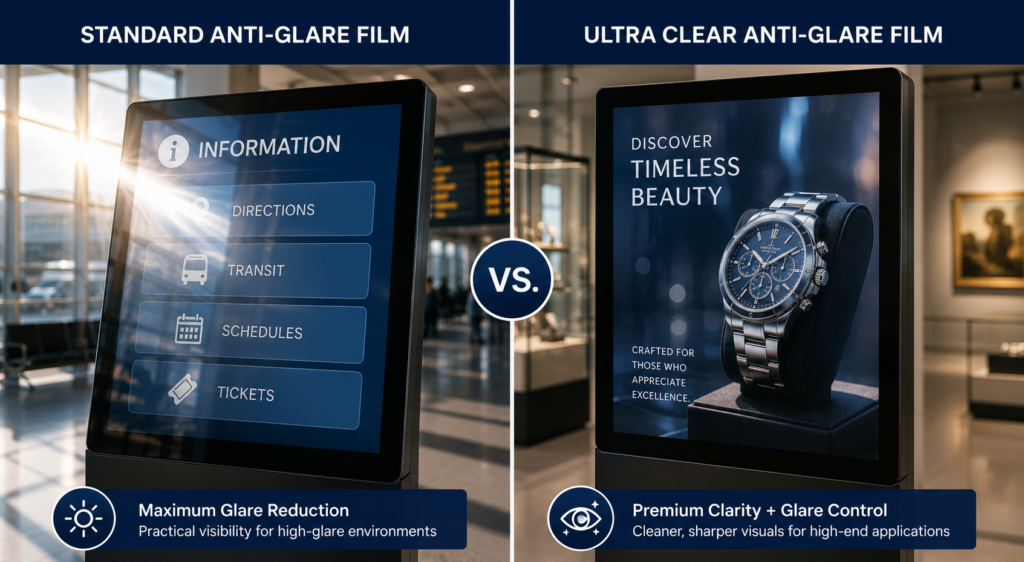
 Standard vs. Ultra Clear Anti-Glare Film: Which One Should You Choose?
Choosing the right anti-glare film comes down to one simple question:
Do you need maximum glare reduction, or do you need glare reduction with a more premium visual finish?
That is the core difference between Standard Anti-Glare Film and Ultra Clear Anti-Glare Film.
Both options are designed to reduce reflections on display-facing surfaces. Both can help improve visibility on glass, acrylic, touchscreens, kiosks, digital signage, menu boards, ATMs, gas pump screens, museums, retail displays, and other commercial applications.
However, they are not identical.
Standard Anti-Glare Film is typically the better choice when glare reduction is the main priority. Ultra Clear Anti-Glare Film is usually the better choice when the display needs to stay sharper, cleaner, and more visually premium.
This guide explains the difference so you can choose the right film for your display, glass, acrylic panel, touchscreen, or commercial screen project.
What Is Standard Anti-Glare Film?
Standard Anti-Glare Film is a practical film solution designed to reduce surface reflections on commercial displays, glass, acrylic panels, protective covers, and touchscreen surfaces.
It is often used when the main problem is harsh glare from sunlight, overhead lights, windows, glossy surfaces, or bright public environments.
Standard Anti-Glare Film is a strong fit for:
- Outdoor displays
- Kiosks
- Gas pump screens
- ATMs
- Menu boards
- Public-facing utility screens
- Acrylic display covers
- Protective glass
- Digital signage
- Transportation displays
- Control room displays
The goal is straightforward: reduce glare so the screen or surface becomes easier to read.
If the screen is used for basic information, payment prompts, ordering menus, schedules, instructions, maps, or self-service interactions, Standard Anti-Glare Film is often the practical choice.
What Is Ultra Clear Anti-Glare Film?
Ultra Clear Anti-Glare Film is designed for applications where glare reduction matters, but image clarity and appearance matter too.
This option is often used for customer-facing displays where the screen needs to look polished, premium, and sharp.
Ultra Clear Anti-Glare Film is a strong fit for:
- Retail storefront displays
- Museum exhibits
- Luxury showrooms
- Premium digital signage
- Corporate lobbies
- Gallery displays
- High-end touchscreens
- Product showcase displays
- Visitor experience screens
- Hospitality displays
The goal is to reduce distracting reflections while preserving a cleaner, more refined viewing experience.
If the screen displays photography, video, branding, product visuals, exhibit content, or premium customer-facing media, Ultra Clear Anti-Glare Film is usually worth considering.
Quick Comparison
| Feature | Standard Anti-Glare Film | Ultra Clear Anti-Glare Film |
|---|---|---|
| Best For | Practical glare reduction | Premium clarity and glare reduction |
| Visual Finish | More functional | Cleaner and more refined |
| Common Uses | Kiosks, ATMs, gas pumps, menu boards, utility displays | Museums, retail, showrooms, premium signage, touchscreens |
| Priority | Reduce glare | Reduce glare while maintaining sharper appearance |
| Content Type | Text, prompts, menus, instructions | Photography, video, branding, product visuals |
| Surface Types | Glass, acrylic, touchscreens, protective covers | Glass, acrylic, touchscreens, premium display surfaces |
| Best Buyer | Operations, facilities, signage, service screens | Retail, museums, hospitality, brand experience |
| Cost Focus | Practical visibility improvement | Premium presentation and user experience |
Both options solve glare problems. The right choice depends on how the display is used.
When to Choose Standard Anti-Glare Film
Choose Standard Anti-Glare Film when visibility matters more than premium image presentation.
This is usually the right option when the display’s job is to deliver information quickly and clearly.
Common Standard Anti-Glare Film applications include:
- Outdoor displays
- Kiosks
- Gas pump screens
- ATMs
- Menu boards
- Transportation displays
- Parking payment screens
- Public information displays
- Utility screens
- Acrylic protective covers
In these environments, the display does not need to look like a luxury showroom screen. It needs to be readable, durable, and practical.
For example, a gas pump screen needs customers to read payment prompts and fuel instructions. A menu board needs customers to see prices and items quickly. An ATM needs transaction prompts to be visible in sunlight or bright surroundings.
In these cases, Standard Anti-Glare Film is usually the workhorse.
When to Choose Ultra Clear Anti-Glare Film
Choose Ultra Clear Anti-Glare Film when the display needs glare reduction without sacrificing a clean visual presentation.
This is usually the right option when the screen is part of a brand experience, exhibit, premium environment, or high-end customer interaction.
Common Ultra Clear Anti-Glare Film applications include:
- Retail storefront displays
- Museums and exhibits
- Luxury product displays
- Corporate lobbies
- Premium digital signage
- Gallery screens
- Hospitality displays
- High-end touchscreens
- Showroom displays
- Customer experience centers
In these environments, the screen needs to look good and perform well.
For example, a museum display should not distract visitors with reflections. However, it also should not degrade the viewing experience of exhibit content. Likewise, a luxury retail display needs product visuals to remain sharp and polished.
This is where Ultra Clear Anti-Glare Film becomes the better choice.
The Main Tradeoff: Glare Reduction vs. Visual Refinement
Every anti-glare solution involves a balance.
The more aggressively a surface diffuses reflections, the more it may affect the way the image looks. That does not mean the screen becomes unusable. However, the surface finish can change how sharp or glossy the display appears.
Standard Anti-Glare Film is usually more focused on practical glare reduction.
Ultra Clear Anti-Glare Film is usually more focused on maintaining a premium-looking image while still reducing reflections.
That is why the right choice depends on the application.
If the screen is a self-service kiosk, strong practical visibility may matter most.
If the screen is a museum exhibit, luxury retail display, or branded showroom screen, image quality may matter more.
One is not automatically “better” than the other. They are built for different jobs.
Standard Anti-Glare Film for Outdoor Displays
Outdoor displays often face the harshest glare conditions.
Sunlight, pavement, glass, vehicle reflections, weather covers, and changing viewing angles can make screens difficult to read.
Standard Anti-Glare Film can help reduce reflections on:
- Outdoor digital signage
- Public information displays
- Parking screens
- Outdoor kiosks
- Transit displays
- Drive-thru displays
- Gas pump screens
- EV charger screens
- Wayfinding displays
For many outdoor applications, practical glare reduction matters more than premium visual polish. Therefore, Standard Anti-Glare Film is often the first option to review.
However, Ultra Clear may still make sense for high-end outdoor retail, hospitality, or brand-facing installations.
Ultra Clear Anti-Glare Film for Retail Displays
Retail displays need to attract attention and communicate clearly.
However, storefront glass, overhead lighting, polished floors, and bright windows can create heavy reflections.
For general retail screens, Standard Anti-Glare Film may work well. However, for premium retail, Ultra Clear Anti-Glare Film is often the better choice.
Why?
Because retail displays often show:
- Product images
- Brand visuals
- Sale campaigns
- Fashion photography
- Luxury product content
- Video loops
- Customer-facing promotions
- Interactive product selectors
If image quality matters, Ultra Clear is usually the smarter direction.
This is especially true for retail storefront displays where the display needs to be visible from outside the store while still looking clean and premium.
Ultra Clear Anti-Glare Film for Museums and Exhibits
Museums and exhibits need a delicate balance.
The surface should reduce reflections, but it should not distract from the artifact, video, touchscreen, or exhibit content.
That makes Anti-Glare Film for Museums & Exhibits a strong use case for Ultra Clear Anti-Glare Film.
Museum applications may include:
- Exhibit display glass
- Acrylic panels
- Interactive touchscreens
- Digital storytelling displays
- Artifact cases
- Visitor center screens
- Gallery displays
- Educational kiosks
- Protected media screens
For these applications, Ultra Clear Anti-Glare Film often provides the best balance between reflection reduction and visual quality.
Standard film can still work for utility displays, maps, directories, or general exhibit support screens. However, for premium exhibit surfaces, Ultra Clear should be strongly considered.
Standard Anti-Glare Film for Gas Pumps and ATMs
Gas pumps and ATMs are utility-driven applications.
Customers need to read prompts, complete transactions, and move through the process quickly.
For gas pump screens, glare can affect:
- Payment prompts
- Loyalty screens
- Fuel instructions
- Receipt options
- Video ads
- Touchscreen buttons
- Confirmation messages
For ATM screens, glare can affect:
- Withdrawal prompts
- Deposit instructions
- PIN and security prompts
- Balance inquiry screens
- Receipt options
- Drive-up visibility
- Touchscreen buttons
In both cases, practical readability matters most. Therefore, Standard Anti-Glare Film is often the better starting point.
Ultra Clear may still be considered for premium banking kiosks, indoor financial centers, or high-end customer-facing displays.
Standard or Ultra Clear for Touchscreens?
Touchscreens can go either direction.
The right film depends on the application.
For utility touchscreens, Standard Anti-Glare Film may be the better fit.
Examples include:
- Ordering kiosks
- Payment terminals
- Parking kiosks
- Gas pump touchscreens
- ATM touchscreens
- Public information screens
For premium touchscreens, Ultra Clear Anti-Glare Film may be the better choice.
Examples include:
- Museum interactives
- Retail product selectors
- Corporate lobby screens
- Hospitality touchscreens
- Showroom displays
- Luxury brand experiences
Before ordering film for any touchscreen, confirm the touch technology, surface type, and whether users touch the film directly.
You can review more details on the Anti-Glare Film for Touchscreens page.
Standard or Ultra Clear for Acrylic Panels?
Acrylic panels are common in commercial display projects because they are lightweight, clear, and easy to fabricate.
However, acrylic can reflect strongly under bright light. It also scratches more easily than glass.
Both Standard and Ultra Clear films can be useful for acrylic, depending on the project.
Use Standard Anti-Glare Film for acrylic when:
- The panel covers a utility display
- Glare reduction is the main goal
- The surface is used for public-facing signage
- The project needs a practical solution
- The acrylic is exposed to harsh glare
Use Ultra Clear Anti-Glare Film for acrylic when:
- The panel protects a premium display
- The surface is used in a museum or retail space
- The acrylic covers detailed visuals
- Image clarity matters
- The display is viewed up close
For more detail, review Anti-Glare Film for Acrylic Panels.
Anti-Glare Film vs. Replacing the Display
Before choosing Standard or Ultra Clear, it helps to confirm whether film is the right solution at all.
If the display is too dim, outdated, damaged, or failing, display replacement may be needed.
However, if the screen still works and the main issue is reflection, anti-glare film may be the better first step.
| Problem | Replace the Display | Add Anti-Glare Film |
| Screen is too dim | May help | Does not increase brightness |
| Surface reflects light | May not solve it | Helps reduce reflections |
| Protective glass causes glare | Still possible | Helps reduce glare |
| Existing display works | Expensive upgrade | Easier retrofit |
| Multi-location project | Higher cost | More practical |
| Surface needs protection | Still exposed | Adds protective layer |
| Image clarity matters | New screen may help | Ultra Clear may help preserve appearance |
The key is to identify the real problem.
If the display is not bright enough, film will not magically fix brightness. If the surface is reflecting light, film can make a major difference.
What We Need to Recommend the Right Film
To help choose Standard or Ultra Clear, send us:
- Width
- Height
- Quantity
- Surface type
- Application type
- Indoor or outdoor use
- Touchscreen or non-touchscreen
- Photos of the display
- Photos showing the glare issue
- Whether clarity or glare reduction matters more
- Desired timeline
- Shipping location
Use the Request an Anti-Glare Film Quote page to send the project details.
If you are not sure which film is right, select “Not sure” and send photos. That is usually enough to start the conversation.
Common Mistakes When Choosing Film
Choosing Standard When Appearance Matters Most
Standard film may reduce glare well, but premium displays may benefit from Ultra Clear Anti-Glare Film.
Choosing Ultra Clear When the Problem Is Harsh Outdoor Glare
Ultra Clear is great for premium clarity, but some rugged visibility problems may need a more practical glare-reduction approach.
Ignoring the Surface Type
Glass, acrylic, touchscreens, and protective covers all need different planning.
Forgetting the Application
A museum display and a gas pump screen do not need the same visual outcome. Different jobs need different tools.
Assuming Film Makes Screens Brighter
Anti-glare film reduces reflections. It does not increase screen brightness.
Skipping Photos
Photos help show glare, surface type, installation conditions, and edge details.
Future Trends: Premium Visibility Is Becoming the Standard
As digital signage becomes more common, customers expect screens to look better in real environments.
That means anti-glare film selection will become more application-specific.
Expect more demand for:
- Ultra Clear films in retail and museums
- Touchscreen-compatible glare reduction
- Custom-cut film for kiosk fleets
- Outdoor visibility upgrades
- Acrylic display cover solutions
- Anti-glare film for EV chargers
- Premium film for hospitality and corporate environments
- Standard film for utility displays and public infrastructure
- Multi-location glare reduction rollouts
The future is not just “put a screen there.”
The future is making sure the screen can actually be seen.
Final Recommendation
Use Standard Anti-Glare Film when:
- Glare reduction is the main goal
- The screen is utility-focused
- The display shows text, prompts, menus, or instructions
- The application is outdoors or harshly lit
- Cost-effective visibility improvement matters
- The project involves kiosks, ATMs, gas pumps, menu boards, or public displays
Use Ultra Clear Anti-Glare Film when:
- Image clarity matters
- The display is premium or customer-facing
- The screen shows photography, video, branding, or detailed visuals
- The application is retail, museum, showroom, hospitality, or corporate
- The display needs a cleaner visual finish
- Visitor or customer experience is a top priority
Still unsure? Send your project details through the Request an Anti-Glare Film Quote page and we’ll help recommend the right option.
Final Takeaway
Standard Anti-Glare Film and Ultra Clear Anti-Glare Film both help reduce reflections, but they serve different priorities.
Standard Anti-Glare Film is the practical choice for glare reduction on utility screens, outdoor displays, kiosks, ATMs, gas pumps, menu boards, acrylic covers, and public-facing displays.
Ultra Clear Anti-Glare Film is the premium choice for retail displays, museums, showrooms, touchscreens, corporate lobbies, and customer-facing screens where image clarity and presentation matter more.
The best option depends on the display, surface, lighting, content, and viewer experience.
If you are not sure which film is right, send us the screen size, surface type, application, and photos. We’ll help recommend the best fit.
FAQ
What is the difference between Standard and Ultra Clear Anti-Glare Film?
Standard Anti-Glare Film focuses on practical glare reduction. Ultra Clear Anti-Glare Film focuses on glare reduction while maintaining a cleaner, sharper visual appearance.
Which film is better for outdoor displays?
Standard Anti-Glare Film is often the better starting point for outdoor displays because practical glare reduction is usually the main priority.
Which film is better for retail displays?
Ultra Clear Anti-Glare Film is usually better for premium retail displays because image quality, branding, and presentation matter more.
Which film is better for museums?
Ultra Clear Anti-Glare Film is often the better choice for museum exhibits, display glass, acrylic panels, and visitor-facing installations.
Can both films be used on touchscreens?
Yes, depending on the touchscreen type and surface. Touchscreen applications should be reviewed before ordering.
Can both films be used on acrylic?
Yes. Both options may work on many acrylic surfaces, depending on the application and visual requirements.
Does Ultra Clear Anti-Glare Film reduce glare as much as Standard?
Ultra Clear Anti-Glare Film is designed to balance glare reduction with a cleaner visual appearance. Standard film is generally more focused on practical glare reduction.
Does anti-glare film make a display brighter?
No. Anti-glare film does not increase display brightness. It reduces surface reflections so the screen can be easier to see.
How do I know which film to choose?
Send your screen size, quantity, surface type, application, lighting conditions, and photos through the quote page. The right film depends on the project.
Sources
3M screen protection products reference glare and screen scratching prevention:
https://www.3m.com/3M/en_US/privacy-screen-protectors-us/
OSHA workstation guidance recommends arranging lighting to avoid reflected glare on display screens:
https://www.osha.gov/etools/computer-workstations/workstation-environment
OSHA monitor guidance notes that monitor angle can create glare from ceiling lighting and that a glare screen may be needed:
https://www.osha.gov/etools/computer-workstations/components/monitors
Screen Solutions International:
https://ssidisplays.com/